
Our Lady of Light is a parish located within the Diocese of Venice, in Florida.
His Excellency Bishop Emilio Biosca Agüero, O.F.M. Cap.
The third Shepherd of the Diocese of Venice
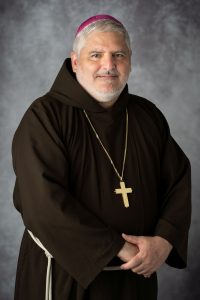
Bishop Emilio Biosca Agüero, O.F.M. Cap. was born December 15, 1964, in Colorado Springs, Colorado, to Emilio Rodolfo Biosca and Maria del Carmen Agüero who were recent immigrants from Cuba. The third of seven children, his two older sisters were born in Cuba. He was baptized on December 25, at St. Patrick’s Church in Pueblo, Colorado.
The family first resided in Pueblo, Colorado, then Kansas City, Missouri, where his father, already a practicing dentist in Cuba, worked and studied, graduating from the University of Missouri-Kansas City (UMKC) School of Dentistry. The family relocated near relatives in Virginia, where his father opened a practice. Bishop Emilio attended St. Anthony and St. Leo Catholic schools, and then Bishop O’Connell High School.
Bishop Emilio studied briefly at George Mason University then entered the Capuchin Franciscans in 1984 transferring to Borromeo College of Ohio in Wickliffe and earning a B.A. in philosophy in 1987. He made first profession of vows in Pittsburgh on July 16, 1988. He continued Capuchin Formation and theological studies at Oblate College in Washington D.C., making solemn vows on August 17, 1991, and earning an M.A. and M.Div. in theology. He was ordained to the diaconate on May 1, 1993, and served at St. John the Evangelist in Center City Philadelphia.
On May 21, 1994, at the Shrine of the Sacred Heart in Washington, he was ordained to the priesthood by then-Bishop Sean O’Malley, O.F.M. Cap., volunteered and was sent to serve in the Capuchin mission in Papua New Guinea. From 1994 to 2004 he served predominantly the Kewa and Wiri speaking peoples in the Kagua, Ialibu and Pangia areas of the Southern Highlands and became fluent in Melanesian Tok Pisin. During this period, he worked closely with lay leaders and catechists. From 2002-2004 he served as the Director of Novices for the Capuchin Novitiate in Pangia.
In preparation for the mission in Cuba, Bishop Emilio returned to the United States in 2005 and studied at the Pontifical John Paul II Institute for Studies on Marriage and the Family at Catholic University in Washington, earning his STL degree (Licentiate in Sacred Theology), Magna Cum Laude.
In 2007, Bishop Emilio entered Cuba and served there for 12 years. He spent his first year in Havana, then three years as Pastor of La Pastora Parish in Santa Clara, and the last eight years in Cuba on the eastern side of the country in the Diocese of Bayamo-Manzanillo, where he was Pastor of La Purisima Concepcion de Manzanillo.
Bishop Emilio was appointed Pastor of the Shrine of the Sacred Heart in Washington, DC on March 1, 2019. The Shrine of the Sacred Heart has 5,000 families and is culturally diverse, offering the Holy Sacrifice of the Mass in five languages each weekend (English, Spanish, Haitian Creole, Vietnamese, and Portuguese).
For the Capuchin Franciscans of the Province of St. Augustine, Bishop Emilio was elected as Third Councilor in 2022, and then as Provincial Vicar, First Councilor in 2025. He is fluent in English, Spanish and Melanesian Tok Pisin.
Bishop Emilio Biosca’s Coat of Arms
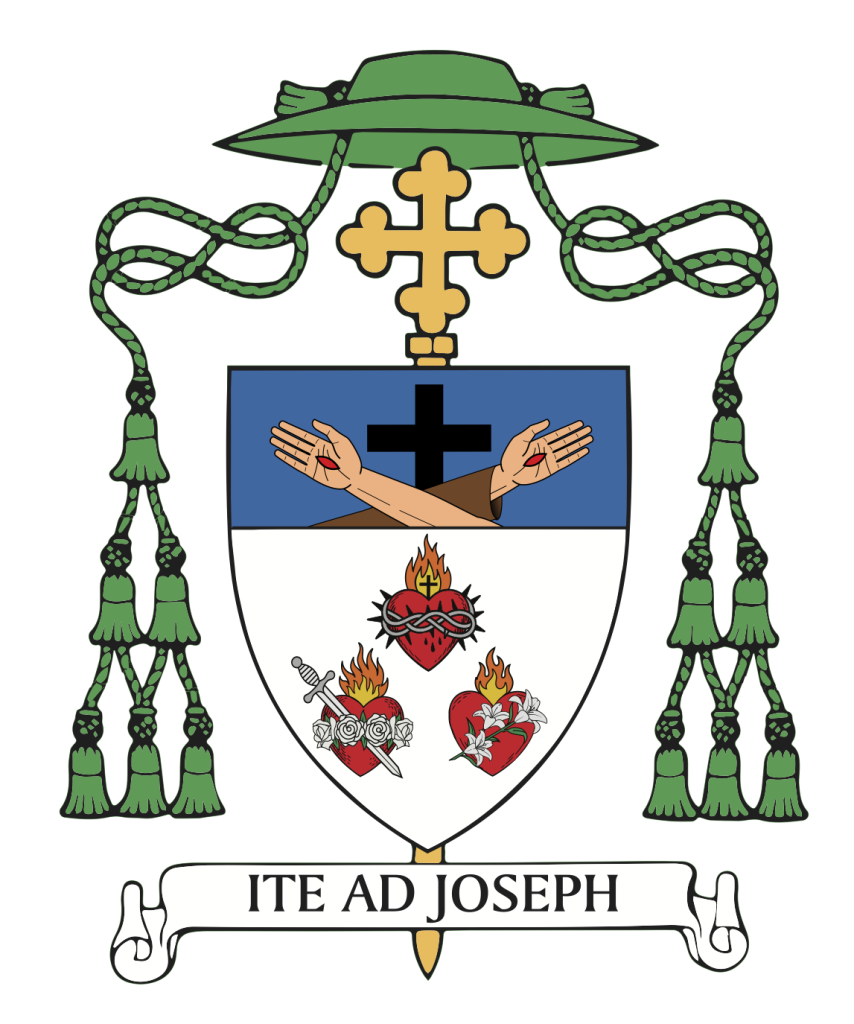
Blazon: Per fess Azure and Argent; in chief the arms of the Franciscan Order: upon a Latin cross Sable two arms in saltire, the one to dexter uncovered and the one to sinister habited on the Order of Saint Francis, both hands displaying the Stigmata, all Proper; in base the Sacred Heart of Jesus between and above on the dexter side the Immaculate Heart of Mary and to the sinister the Chaste Heart of Saint Joseph, one and two, all Proper.
Motto: ITE AD JOSEPH
Coat of Arms Explanation:
In the upper portion of the shield, the two crossed arms before a cross represent the bare arm of Jesus Christ crucified, the hand bearing the wound of crucifixion, reminding believers of Christ’s sacrificial love and redemption, and the arm of Saint Francis of Assisi clothed in simplicity, emphasizing poverty, humility, and discipleship. Saint Francis also bears the stigmata, the wounds of Christ, which he received on Mount La Verna in 1224.
The cross behind the arms signifies that both Christ and Francis are united through the mystery of the Cross. It reflects the Franciscan desire to follow Christ completely, especially in humility, suffering, and love.
In the lower portion of the shield, the silver background represents transparency, truth, and justice. The Sacred Heart of Jesus symbolizes Christ’s divine love for humanity, self-sacrificing, merciful, and redemptive. It is usually shown aflame, in the passion, pierced, and crowned with thorns. The Immaculate Heart of Mary represents her pure and immaculate love, her obedience to God, and unity with her son’s mission. It is usually depicted pierced by a sword, recalling her sorrow and joy. The Chaste Heart of Saint Joseph signifies the faithful, protective, and self-giving love, marked by chastity, humility, and loving obedience to God’s will. The three hearts together symbolize that
the human person is revealed through love and is made for self-gift and communion. It expresses that human love, marriage, and the family is a communion of persons, central to the new evangelization, that truth, goodness, and beauty are united. The red hearts also recall the first Franciscan Missionary Martyrs in 1220. When Saint Francis of Assisi heard of their deaths, he declared, “Now I can truly say that I have five Friars Minor,” recognizing in them the authentic spirit of humility, sacrifice, and evangelical love that he desired for his brothers.
The Bishop’s motto, ITE AD JOSEPH, is from Genesis 41: 55, “Ite ad Ioseph; et quidquid ipse vobis dixerit, facite.” (Go to Joseph; and whatever he says to you, do.” “Vayan a José y hagan lo que él les diga.”)
The coat of arms was devised by Bishop Biosca with advice from Very Rev. George E. Stuart and Georgina Wilkinson.